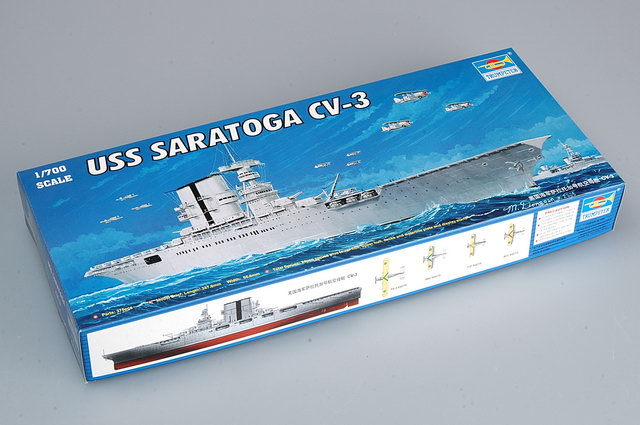
USS Saratoga CV-3 1/700 Aircraft Carrier Ship Model Kit | Trumpeter 05738
Kit Introduction
Trumpeter’s 1/700 scale USS Saratoga CV-3 (Kit No. 05738) is a static plastic model kit representing the carrier in her pre‑war configuration circa 1936.
Specifications & Features
-
Scale: 1/700
-
Model length: 387.9 mm
-
Model width: 55.6 mm
-
Total parts: 375
-
Sprues: 24 (including lower hull, upper hull, decks, waterline plate, display stand)
The kit is molded in light gray, clear, and red styrene. Builders can choose a full‑hull version (with display stand) or a waterline version (with a clear plastic ocean diorama base).
Aircraft complement is a highlight: 33 clear styrene aircraft representing a mid‑1930s air group:
Instructions and markings: The 12‑page English instruction booklet includes clear assembly drawings and text notes, plus a separate full‑color three‑view painting guide. Paint references are provided for Gunze and Mr. Color. The decal sheet includes all flight deck markings, 48‑star U.S. flags, wing stars, and section chevrons for aircraft, representing VF‑6B (F3Fs), VS‑2B (SBUs/BFCs), and VT‑2B (TG‑2s).
Modeler feedback: The kit has almost no flash, and ejector pin marks are hidden where they won’t be seen. The air wing is praised for its quantity and variety, and the decals are of good quality. Fit is described as “just alright,” but overall quality and detail are very good for the scale. Aftermarket photo‑etch detail sets are available (e.g., Eduard, with two PE sheets including safety rails, nets, ladders, crane upgrades, and arresting gear).
This kit is an excellent choice for intermediate and experienced modelers interested in pre‑war U.S. naval aviation. It offers a colorful, historically significant subject with multiple presentation options.
Historical Background
USS Saratoga (CV-3) was one of the first fast aircraft carriers of the U.S. Navy and the third carrier to enter service. Originally laid down on 25 September 1920 as a Lexington-class battlecruiser (CC-3) at the New York Shipbuilding Company, she was converted into an aircraft carrier while under construction due to the limitations of the 1922 Washington Naval Treaty. Launched on 7 April 1925 and commissioned on 16 November 1927, she spent her entire career with the Pacific Fleet.
As one of only three prewar U.S. fleet carriers (alongside Enterprise and Ranger) to serve throughout World War II, Saratoga played a key role in developing carrier tactics during the 1930s. She famously conducted a successful surprise attack on Pearl Harbor during fleet exercises — foreshadowing the Japanese attack years later. When Pearl Harbor was struck on 7 December 1941, Saratoga was entering San Diego after drydocking at Bremerton. She sortied the next day as the nucleus of the third carrier force. On 11 January 1942, she was hit by a torpedo from Japanese submarine I-16 but survived. In August 1942, she served as Rear Admiral Fletcher‘s flagship during the Guadalcanal landings, providing air cover. After the war, Saratoga was deemed surplus and assigned to Operation Crossroads — the atomic bomb tests at Bikini Atoll — where she was sunk. She received seven battle stars for her WWII service.