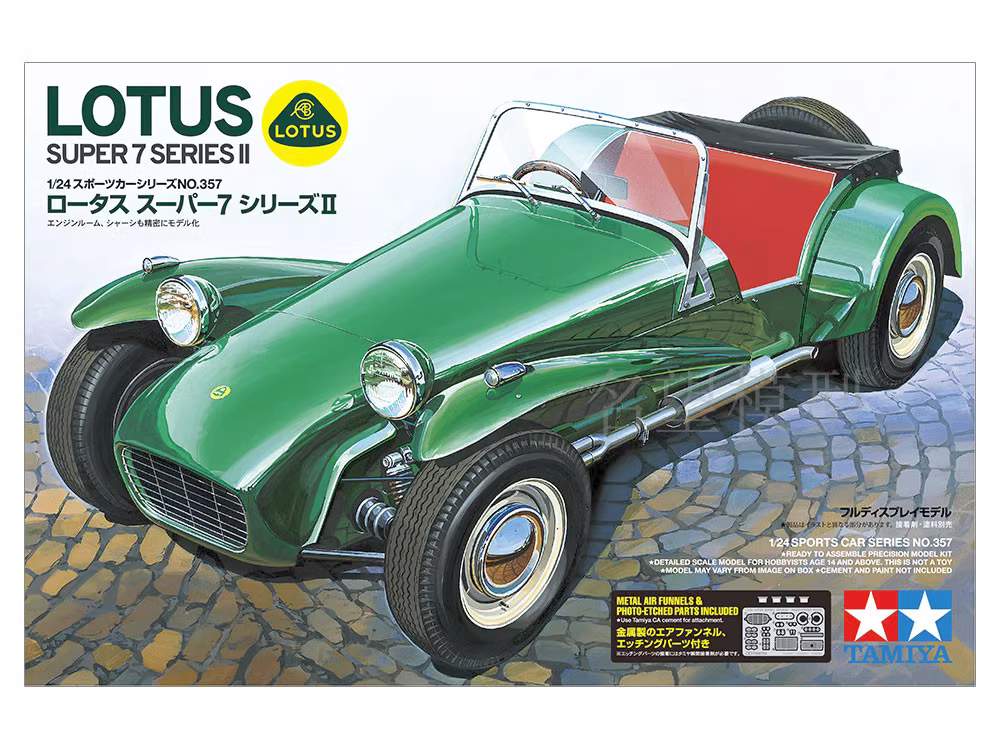
[The origin of lightweight sports cars that continue to shine]
--Lotus 7 is a masterpiece of lightweight sports cars produced by British sports car maker Lotus from 1957 to 1973.
¨D¨DOf the Lotus 7 made up to Series IV with improvements, Series II is the most mass-produced type announced in 1960.
--The frame has been redesigned, the rear suspension has been modified, and the wheels have been reduced from the previous 15 inches to 13 inches.
--The nose cowl and front and rear fenders that were made of aluminum have been changed to FRP.
¨D¨DIn addition, the one with a high-performance engine such as Cosworth was called Super 7.
¨D¨DSince 1973, production at Lotus has been discontinued, but Lotus dealer Caterham has purchased the equipment and continues production and sales.
¨D¨DWe changed the name to Caterham Seven, and we are still sending out various Sevens for enthusiastic enthusiasts.
[Model outline]
--1/24 scale, total length 139mm, total width 61mm, total height 41mm.
-The simple form of the open 2-seater, which is said to be the origin of lightweight sports cars, is modeled as it is.
--The in-line 4-cylinder engine accurately reproduces the carburetor, exhaust pipe, and mission.
-The characteristic front suspension in which the stabilizer doubles as the upper arm, and the rigid type rear suspension that supports the axle with the trailing arm and A-type diagonal link are also realistically finished.
¨D¨DMetal air funnels, etched parts such as the front grille, and seat belts are set to enhance the appearance of the finished product.
-Headlight rings and hubcaps are plated parts.
-It can also be assembled to Clubman race specifications equipped with a racing screen and roll bar.
¨D¨DThe photo shows the kit assembled and painted.
( This is a machine translation. Please allow for possible misinterpretations in the text. )